
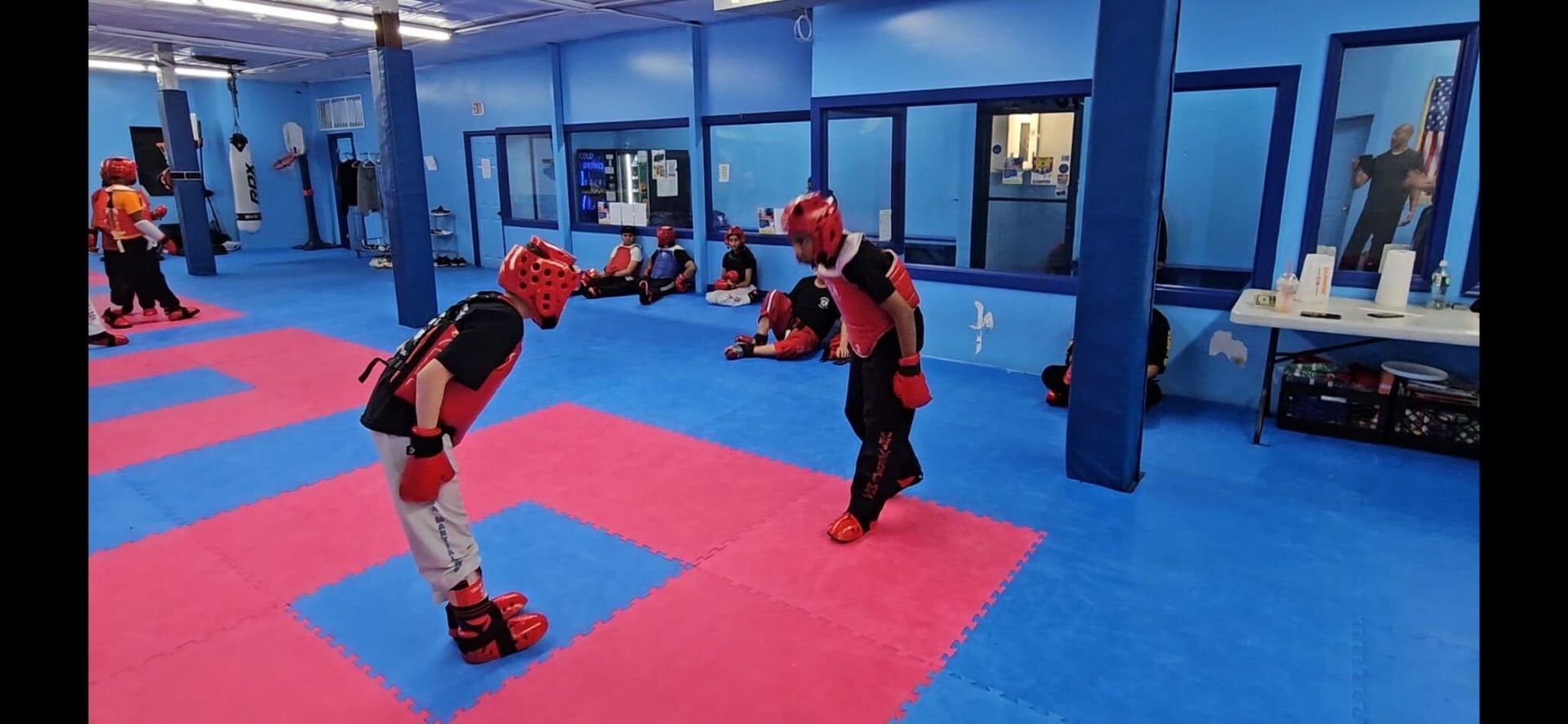
The right Youth Mixed Martial Arts class doesn’t just teach punches and kicks - it shapes how kids handle school, stress, and confidence.
Parents usually find us for one simple reason: you want your child to feel stronger on the inside and healthier on the outside. Youth Mixed Martial Arts does that in a way that feels active and fun, not like another lecture or another screen-based activity.
In our South Richmond Hill gym, we keep Youth Mixed Martial Arts structured, age-appropriate, and positive. Kids learn real technique, but the bigger win is what happens around the technique: better listening, better emotional control, more grit when something feels hard, and a calmer kind of confidence that shows up at home and in school.
Below are the seven skills we see kids build most consistently, and how we coach each one through smart training, clear expectations, and steady progress.
Why Youth Mixed Martial Arts works so well for kids
Youth Mixed Martial Arts is unique because it blends several ranges of movement: striking, clinch control, takedown basics, and ground awareness. That variety keeps kids engaged, but it also trains the whole body and mind. A class can include footwork patterns, partner drills, reaction games, and technique practice that requires focus without feeling boring.
Just as important, our sessions run on routine. Kids check in, warm up, drill, and cool down. That predictable flow helps most children settle in quickly, and it can be especially helpful for kids who learn differently and thrive with clear structure.
When parents ask if MMA is safe for kids, our answer is simple: it’s safe when it’s coached correctly. We focus on control, supervision, proper equipment when needed, and progressions that match a child’s age and experience. For young kids, that means skill-building first, not hard contact.
Skill 1: Confidence that looks calm, not cocky
Confidence in kids is rarely about being loud. It’s about being willing to try, even when the outcome isn’t guaranteed. In Youth Mixed Martial Arts, kids gain confidence by learning a technique step by step, practicing it repeatedly, and seeing proof that improvement is real.
We build confidence through small, winnable challenges. A child learns how to stand properly, then how to move, then how to keep hands up, then how to combine movements. Each layer stacks into something bigger. Over time, kids stop asking, “What if I mess up?” and start thinking, “I can figure it out.”
You’ll often notice the change outside the gym first. Parents tell us kids speak up more in class, raise their hand, or handle social situations with less hesitation. It’s not magic. It’s earned.
Skill 2: Discipline that becomes a habit
Discipline is doing what needs to be done even when you’d rather do something else. In our Youth Mixed Martial Arts program, discipline isn’t enforced through harshness. It’s taught through consistency and standards.
Kids learn that class has rules and a rhythm. We line up, we listen, we practice safely, and we respect partners. If a child loses focus, we redirect quickly and clearly, then get them back into the drill. That loop - attention, correction, re-focus - is discipline training in real time.
Over weeks, that discipline becomes a habit. Kids start to anticipate what’s expected: showing up on time, keeping gear organized, following instructions, and finishing rounds. Those are life skills, not just gym skills.
Skill 3: Physical fitness that doesn’t feel like “working out”
A big reason families choose Youth Mixed Martial Arts Richmond Hill classes is that kids need movement that actually holds their attention. Fitness improves fastest when a child wants to participate.
Our classes develop:
• Cardiovascular endurance through drills, footwork, and paced rounds that keep kids moving
• Coordination and balance through stance work, pivots, level changes, and controlled partner movement
• Strength and mobility using bodyweight patterns, light resistance, and safe athletic positioning
• Agility and reaction speed through games and cue-based training that rewards quick thinking
• Body awareness through grappling basics that teach how to move with control in close range
There’s also good research supporting these outcomes. A systematic review in 2022 found MMA training can improve cardiorespiratory fitness, agility, strength, and balance in children. In plain language: this is real athletic development, not random activity.
Skill 4: Self-control under pressure
Self-control is one of the most important benefits of Youth Mixed Martial Arts, and it’s also one of the most misunderstood. People worry combat sports will make kids aggressive. Our experience is usually the opposite: when kids learn rules, boundaries, and controlled intensity, they become more regulated.
We coach self-control in a few practical ways. Kids learn to wait for a cue, to stop instantly when a coach says stop, and to match their partner’s pace. If a child gets frustrated, we teach them to reset: breathe, listen, try again. That reset skill matters everywhere, from classrooms to sibling arguments.
We also teach kids that technique comes before power. When a child understands that control is the goal, power stops being the obsession. That’s a healthy shift.
Skill 5: Respect that shows up in everyday behavior
Respect in martial arts isn’t just saying yes sir or yes ma’am. Respect is how you treat your coach, your partner, and yourself. In our Mixed Martial Arts Richmond Hill, NY youth classes, we build respect into the culture of training.
Kids learn to partner safely, avoid reckless movement, and look out for each other. They learn that someone smaller deserves the same care as someone bigger. They learn that listening is part of being a good teammate, even in an individual sport.
We also talk about respect for boundaries. If a partner says something is uncomfortable, we adjust. If someone needs a break, we give space. Those lessons matter, and you can feel them in the room when a class is running well: focused energy, not chaos.
Skill 6: Mental resilience when things don’t go their way
Every child needs resilience, because life has bad days. A technique feels awkward. A drill doesn’t click. A partner is faster. Youth Mixed Martial Arts creates safe, manageable moments of struggle, and that’s exactly where resilience grows.
We teach kids to reframe setbacks as information. If a child can’t keep balance during a takedown drill, that isn’t failure - it’s feedback. We adjust the stance, slow it down, and repeat. When kids learn that improvement is available, frustration loses its power.
This is also why we keep progress visible. When kids can see that last month’s “hard” is now today’s warm-up, it changes their self-image. They start to believe effort works. That belief is resilience.
Skill 7: A growth mindset that turns training into long-term progress
A growth mindset is the understanding that skills are built, not gifted. In Youth Mixed Martial Arts, kids experience growth mindset every time they drill. Nobody walks in with perfect footwork. Nobody starts with effortless coordination. Progress comes from practice.
We help kids set small goals, because small goals create momentum. Maybe your child wants to remember a three-move combo. Maybe it’s staying focused for an entire round. Maybe it’s simply speaking up when confused instead of shutting down. Those goals are real, and when kids hit them, they learn a powerful lesson: improvement is something you can choose.
That mindset often carries into school. Kids become more willing to study, to ask questions, and to keep trying when a subject isn’t instantly easy. The gym becomes proof that learning is a process.
What a typical youth class looks like in our gym
Parents like to know what actually happens in a Youth Mixed Martial Arts session, especially if your child is new. While the exact plan changes based on age and experience, our class structure usually follows a clear flow so kids feel oriented and supported.
1. Check-in and warm-up that builds basic athletic movement and injury prevention habits
2. Technique instruction with simple cues so kids understand what to do and why
3. Skill drills that repeat the technique with a partner, focusing on control and safety
4. Conditioning games that build endurance without kids feeling like it’s “gym class”
5. Cooldown and review so kids leave remembering the key lesson of the day
That structure is one reason you’ll see changes quickly. Many families notice better focus and confidence within four to six weeks of consistent attendance, because repetition and routine add up.
Common parent questions we hear in South Richmond Hill
Kids’ programs come with practical questions, and you deserve clear answers.
Is it safe? Yes, when coaching is responsible and training is supervised. We build skills progressively and keep intensity appropriate for the age group.
Do kids need gear right away? Most beginners can start with comfortable athletic clothes. We introduce gear as your child progresses and as drills require it.
What age can kids start? Many children can begin around ages five to six with the right class design, attention span expectations, and coaching style.
Will this help with bullying? While we never promise outcomes we can’t control, we do teach posture, awareness, confidence, and boundary-setting, which can reduce how “easy” a child looks as a target.
Take the Next Step
Building these seven skills takes time, but it doesn’t have to be complicated. With the right coaching, Youth Mixed Martial Arts becomes a steady weekly practice that shapes confidence, discipline, fitness, self-control, respect, resilience, and a growth mindset in ways you’ll notice at home.
If you want a program that’s structured, age-appropriate, and rooted in positive standards, we’d love to help you get started at Universal Mixed Martial Arts here in South Richmond Hill. You can use the website and the class schedule to find a routine that fits your family, then watch your child grow into it week by week.
Train with purpose and make steady progress through the well-rounded martial arts programs at Universal Mixed Martial Arts.